

Why is it so hard for an ordinary salaried Indian to get a small loan?
Ranvir Singh and Krishnan Vishwanathan came to that question from different directions. They met at McKinsey, both IIT engineers, Ranvir from Bombay and Krishnan from Delhi, and both had spent years in financial services before consulting. Ranvir had worked in PSUs, private sector banks, and NBFCs. Krishnan had gone to Yale for his MBA and built technology products for financial companies in the Bay Area. From inside banks and from inside fintech, they had seen the same gap from both sides.
Not the very poor. Not the very rich. The young professional earning thirty or forty thousand rupees a month, buying her first laptop at a consumer electronics store. The small business owner who needs working capital for three months. People with steady incomes and real repayment capacity, who either had no credit history or found the process of applying at a bank too slow, too cumbersome, and too often ending in rejection.
In 2015, they left McKinsey and started Kissht.
The Credit Gap
The problem was never intent. Banks wanted to serve this segment. Their systems simply weren't built for it. Approving a loan required documentation, branch visits, bureau checks, and underwriting processes designed for a different kind of borrower. For a first-time borrower with no bureau trail, the answer was usually no.
Ranvir and Krishnan believed these borrowers could be assessed differently. A person's digital behaviour, how they used their phone, how they transacted, patterns across hundreds of small signals, contained information about their creditworthiness, if you had the models to read it. The bureau trail was one way to assess someone. It was not the only way.
So they built a lending platform that could underwrite borrowers at the point of need, in minutes. A customer at a merchant store could scan a QR code and get a credit decision before leaving the shop. Someone on a marketplace app could access purchase financing without visiting a branch or touching a paper form. The platform connected to both online and offline merchants, which meant Kissht could meet borrowers where they already were. The NBFC subsidiary, Si Creva Capital Services, handled the lending itself: disbursements, KYC, and collections. The structure was deliberate. It kept the business inside RBI frameworks from day one, a decision that would matter more than anyone could have predicted.
Building Through the Hard Years
Kissht raised $133 million across eleven rounds. Endiya Partners wrote the first institutional cheque in 2017. Vertex Ventures, Fosun RZ Capital, and others followed. The growth was real. It was not uninterrupted.
In late 2023, during a government enforcement action against illegal lending apps, Kissht was briefly and incorrectly included in a block list. The founders engaged directly and transparently with regulators, and the company was restored to full operations. How Kissht handled that moment, not by going quiet but by demonstrating its compliance standing clearly, said something about how the business had been built. The compliant structure they had chosen in 2015, when it was the harder and slower path, was what carried them through.
A year later, the RBI tightened norms on unsecured lending across the sector, raising risk weights on personal loans and increasing the cost of capital for digital lenders broadly. FY25 felt it: revenue fell from ₹1,674 crore to ₹1,337 crore, profit from ₹197 crore to ₹161 crore. Disbursements slowed.
Here is what Kissht did not do. It did not loosen underwriting to chase volume. NPA ratios rose, as they did across the sector, but stayed within ranges that reflected a managed credit cycle, not a deteriorating business. The discipline cost growth in the short term. It is also why there was a business left to compound.
By the nine months ending December 2025, the numbers told the story. Revenue of ₹1,560 crore. Net profit of ₹199 crore. AUM of ₹5,956 crore, compounding at close to 80% annually between FY23 and FY25. 11.17 million customers served. 63.73 million registered users.
The IPO
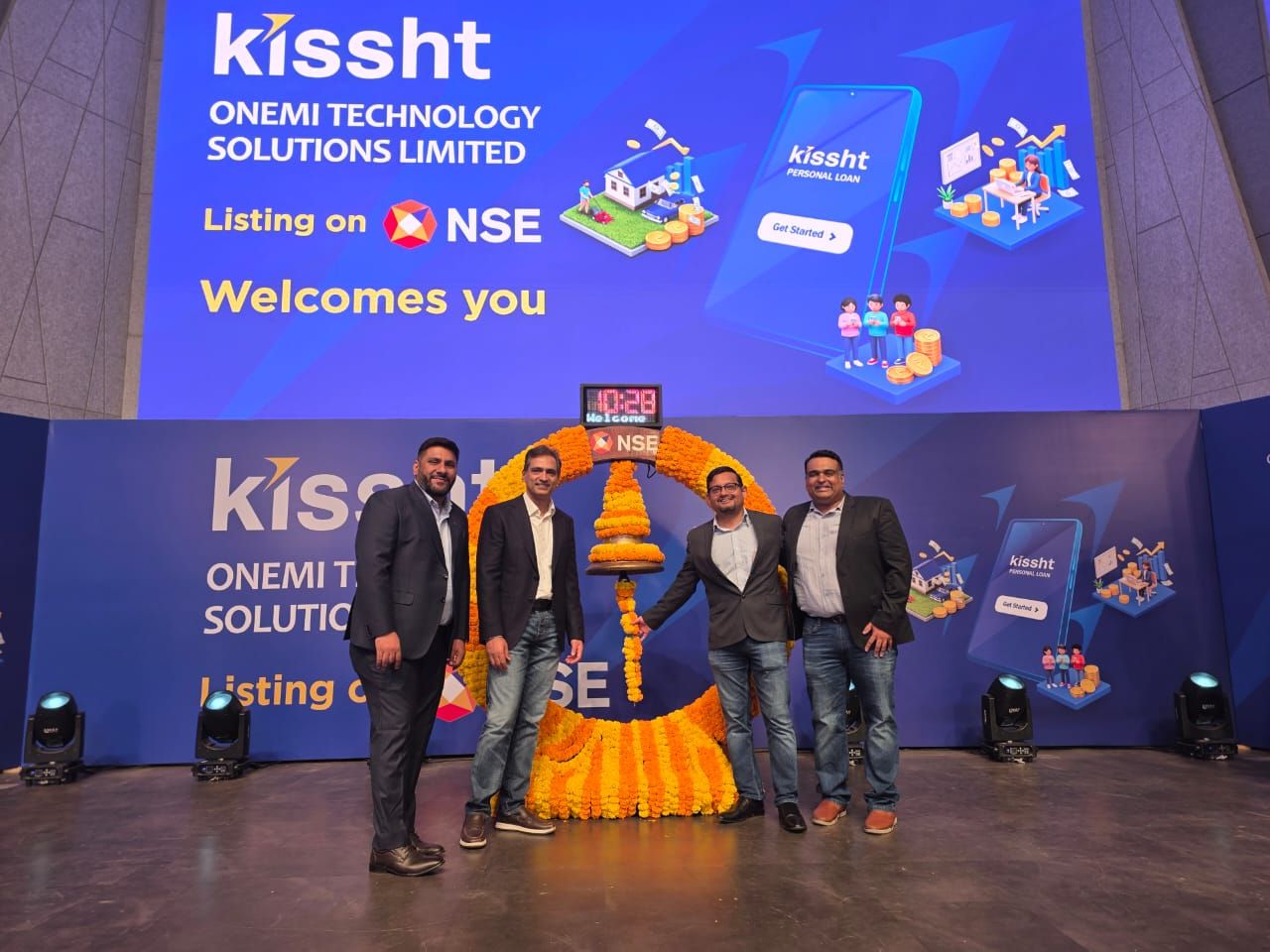
On May 8, 2026, OnEMI Technology Solutions, the parent entity that operates Kissht and its payments app Ring, listed on the BSE and NSE. The IPO raised ₹926 crore and was subscribed nearly 10 times overall. Institutional investors, the category that spends the most time with the financials and asks the hardest questions, oversubscribed their portion 26 times. The stock opened at ₹191, an 11% premium to the issue price.
Something quieter also happened. During the IPO process, Ranvir and Krishnan invested approximately ₹40 crore of their own money into the company, at a premium to the price band. For founders who have spent a decade building, this is not an obligatory gesture. It says something about what they believe comes next.
Ten Years in the Making
Kissht is among the first pure-play digital lending platforms in India to list on the public markets.
India still has a large credit gap. The salaried middle class remains underpenetrated by formal lenders. Small businesses face a financing shortfall that runs into the trillions. The conditions that made Kissht's founding thesis plausible in 2015 have not gone away.
What this listing demonstrates is something that was genuinely uncertain a decade ago: that this segment can be served responsibly, at scale, over a long period, and that the public markets will recognise the business that does it. That case had to be made, through two regulatory storms and a credit cycle. Ten years later, it has been.
Trifecta Capital is proud to have been a venture debt partner to Kissht on this journey. Congratulations to Ranvir, Krishnan, and the entire Kissht team. This has been a long time coming, and it is well deserved.