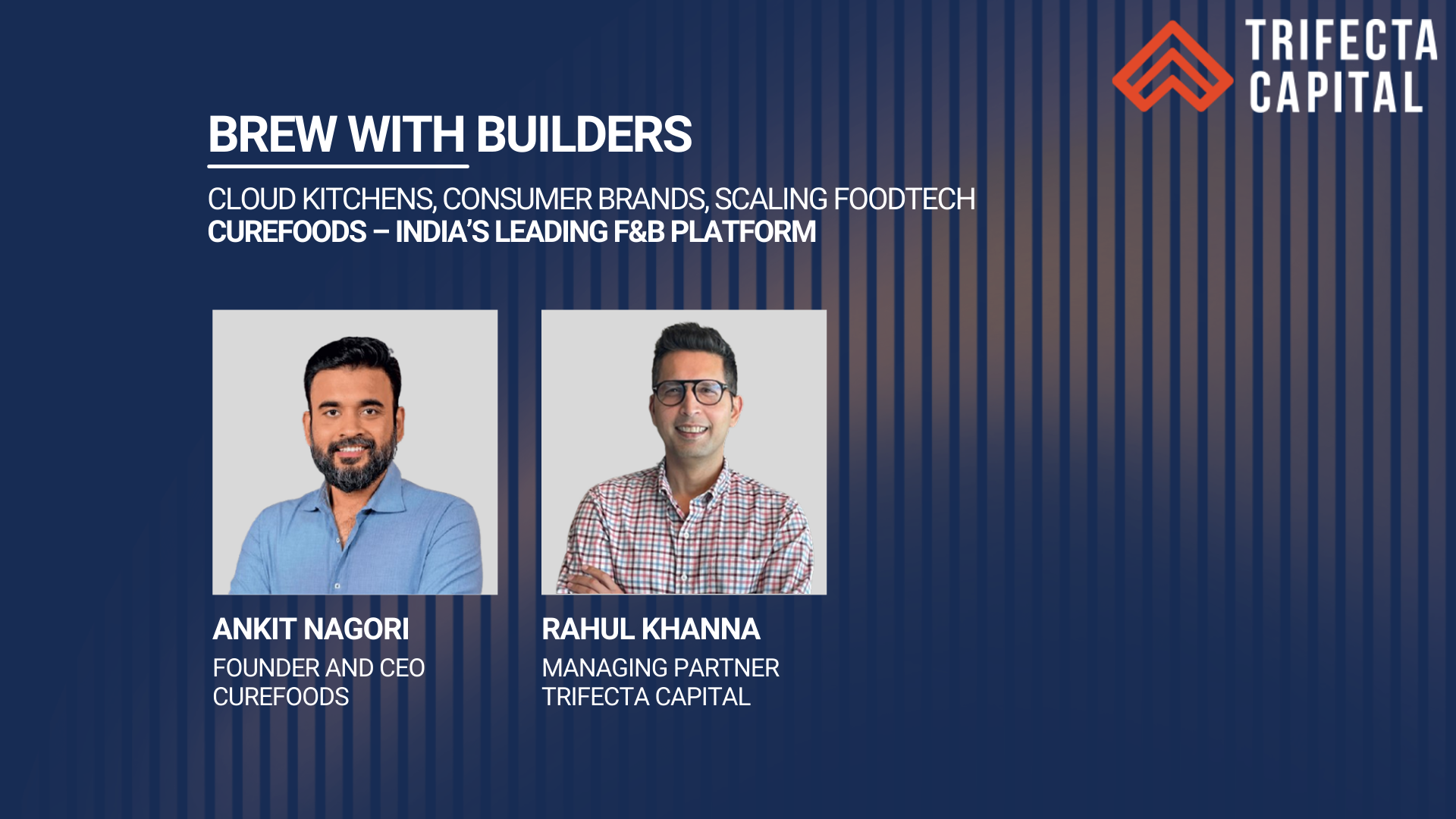


This is the full transcript of the Brew with Builders session featuring Ankit Nagori, Founder of Curefoods, in conversation with Rahul Khanna of Trifecta Capital. The transcript has been lightly edited for readability while preserving the original discussion in its entirety. For a condensed overview of the key insights and themes covered in this session, click the Summarize AI button available on your preferred platform.
Welcome and Introduction
RAHUL [Host]: We've been trying to find a way to engage our portfolio companies in a more meaningful manner. We've got some pretty heavy hitters in our portfolio — many of you we've known for several years now. We also have a bunch of companies in our portfolio that are a lot younger, and once a quarter we try to get them together in different cities. We've had the pleasure of doing a session with Vidit at Meesho, last year we did something with Darpan at Glamplus, we did something with Abhiraj at Urban Company — so by rotation, typically across Delhi, Bombay, and Bangalore, we gather our portfolio companies.
The idea is to have an open conversation between founders — partly about their journey, partly about their challenges — and then to leave it open for discussion. We have the privilege of having some very high-quality people who are a little further along in their journey, and hopefully some of you sitting on that side of the table will give me the pleasure of having you on this side of the table in a few years.
The plan is to spend the next 30 to 45 minutes talking to Ankit, and then open it up to Q&A. Whatever happens in this room stays in this room — no tweeting, no posting — so feel free to ask difficult questions.
Ankit, thank you for hosting us. Ankit and I have known each other coming up to 10 years now — which in startup land is like a lifetime. He's changed a couple of logos since then, I've changed a couple of logos since then, but we're still at it, and I think both of us wouldn't be doing anything else.
I won't spend a lot of time introducing Ankit — most of you know him. He's had a stellar track record as a serial entrepreneur. I thought I'd start with an easy question to get you warmed up: what is a day in the life for Ankit Nagori like now?
Life as a Founder Today: Structure, Rituals, and the Weekend Circuit
ANKIT: Thanks for having me, Rahul — really looking forward to this.
A typical day for me starts with my own set of rituals around wellness — a workout, meditation for sure. In the first two hours of the day, I want to get things organised: finish emails, get stuff lined up. Those first three hours are very critical, and given the kind of lives we lead, having structured planning is very important.
By the time I get to the office, it's full action time. The first half of the day is a bunch of review meetings. The second half is for slightly longer-term conversations — we have a culture of doing product-solving sessions in the company, so we schedule a lot of those based on customer feedback and business feedback. Second half of the week, I try to go out, meet customers, spend time at the kitchens. Saturdays are also a lot about going out — we now have a pretty sizable offline business, and I love meeting customers and analysing things on the ground.
I have a nine-year-old son, and I've been married for about 12 years. My wife helps with the newly structured family office fund. My son plays badminton and is doing well in the sport, so on Sundays I take him around the competition circuit — that takes a lot of time.
Solo vs. Co-Founder: The Honest Truth About Going It Alone
RAHUL: You've been part of a two-founder team, you've started another business with a co-founder, and now you're going solo. Any lessons on the one-founder versus two-founder model?
ANKIT: Going solo should be the last option — there's no doubt about it. Entrepreneurship is such a tough journey. In my case, I don't have a co-founder in the traditional sense, but I have an operating head and CEO of the company who's been with me from day minus ten — he was at Cult.fit earlier. It's still not a replacement for having a co-founder, but I'm halfway there.
For people who are completely solo, I just think it's incredibly difficult. There'll be tough days, really terrible days — real issues around compliance, regulatory matters, showing up at a GST office or tax office. These are genuinely hard problems. If you're solo, they just break you down.
My belief is that for any entrepreneur, about 70% of days are bad — it's just that the 30% good days are so good that they balance it out. And for any company to succeed over a 10-year period, you just need 21 good quarters out of 40. The problem is: if seven or eight of those 19 bad quarters come in a row, a solo founder can break down. It will show in the team, communication becomes shallow, and pessimism seeps through.
From purely observing the companies I've invested in, three co-founders is usually too many — though there are enough examples of three or four founders clicking. But even in a two-founder setup, clearly identifying one leader — the person where the buck finally stops — is very important. A lot of two-founder companies don't do this well, especially when it's best friends who started together. That tough conversation gets avoided, and I see a lot of conflicts arising from it later.
Two is definitely the best setup. Solo founding is a different thrill, but it's done at your own risk.
Building a Support System: Board Members, Mentors, and the Ecosystem
RAHUL: You talked about it being a lonely journey. Who do you go to when you need help — do you have a coach, a mentor?
ANKIT: I've very carefully crafted my board, and I was lucky enough to choose investors I also looked up to personally.
Bejul is a very close friend and has been a coach, mentor, and boss all in one. Prashant Prakash is someone I've deeply respected over the years — he continues to be a mentor not just at a business level but at a personal level. Sudhir has been on the board of almost all my companies over the last 12 to 13 years. Anand Prasanna — who I almost co-founded this company with — was the person who along with Anand from Iron Pillar put in money to start this venture.
I actually use the board the right way. A lot of founders treat the board as a liability — I really don't. I use them to brainstorm and discuss. I have a one-on-one relationship with all of them: one full board meeting a quarter and then individual one-on-ones every month. We also recently added an external board member, Avi, who was the CEO of Starbucks India earlier — she's added a lot of F&B knowledge to our thinking.
Beyond the board, I'm very open to seeking help across the ecosystem. I reach out to Kunal very often — his consumer insights are the best in the country. Sitting in Indiranagar, the insight he has about every city in India is unbelievable. I also reach out to Subh from Accel fairly regularly. No one ever says no when you ask for help, and people generally give genuinely good advice.
I think within the founder community we should try to create more of that feedback loop. There have been efforts — X2-10x is a good one, and Piyush and Nikhil have done a wonderful job there. But I feel there's room for a proper first-gen founder platform — something like the equivalent of a YPO, but for operators and first-generation founders. Not second or third generation, because their challenges are completely different — succession, family land division. A first-gen platform that really connects founders in a meaningful way doesn't quite exist yet.
Building Curefoods: From Eatfit to a House of F&B Brands
RAHUL: Let's talk about the business. You grew first online, then offline, and you've done both inorganic and organic expansion. There was a time when there was a lot of excitement about inorganic growth — it seems to have cooled off. Can you walk us through the journey?
ANKIT: To help you understand this, I'll take you back to the pandemic period.
While building Cult.fit, we had incubated an idea called EatFit. By March 2020, EatFit was an 18-month-old business just getting started. Cult had built a community of around 200,000 customers paying roughly ₹1 lakh in LTV a year, and we asked: how do we monetise them further? Food was the natural answer, so EatFit became a $5–18 million business.
Then the pandemic hit. Cult shut down, but cloud kitchens were taking off worldwide. The question was: how do you monetise that kitchen asset when your core business is closed? People at home weren't looking for healthy delivery — they were cooking at home and craving indulgent food. Entertainment food, as I call it.
We had central kitchens already, so we decided to add new cuisines. But building brands from scratch is the toughest thing — it requires deep craft, real inspiration, the creator really has to build something meaningful. So we started looking at smaller operators who had already built something real. Nomad is one example — they were a single kitchen in Delhi doing ₹30–40 lakh in revenue. Pizza Baker and Hundo in Bombay were also taking off. We approached these founders and said: we have the stack — the technology, central kitchen, dark stores — let's invest and take your brand to other cities.
We had scaled to 60 kitchens before the pandemic, then cut back to 20 kitchens and one central kitchen. The stack worked — Pizza, Biryani, and Health. We each put in $5 million of personal capital, and that ₹10 million gave us ₹3–4 million in ARR, with money still in the bank. Six months in, we knew it was working.
That's when we started acquiring brands — a dessert brand, a Biryani brand, a more affordable pizza brand. We were not a typical inorganic acquirer in the ghost kitchen sense. Ghost kitchens were buying storefronts; we already had storefronts. We were buying selection and credibility. I wasn't confident I could build a 9/10 Biryani from scratch — it's an old-school, legacy product. But we found a player who already had 20 cloud kitchen outlets. The moment we acquired them and integrated them into our infrastructure, costs dropped immediately. Every new kitchen we opened launched with four brands from day one — faster market growth, better unit economics.
We're now at around 300 locations doing close to ₹100 million in ARR.
Going Offline: Cities 30 to 50 and the Sharief Biryani Model
RAHUL: At that scale, how do you think about going further — beyond the top 10 cities?
ANKIT: India doesn't have the online demand density beyond the top 10 cities for cloud kitchens. So to go to city numbers 30 to 50 — which we're now starting — we need offline storefronts. But not all our brands are suited for it.
Nomad is an outlier in our offline strategy because it's genuinely an experience store — more like a D2C brand with a physical presence — and it makes money. But the brands we've chosen for broader offline expansion are middle-tier brands.
Our biggest offline bet is Sharief Biryani. We now have about 50 proper sit-down restaurants — 50 to 60 seaters — that are very profitable. They return capital in 16 to 18 months. Sharief is already in cities like Hassan, Tumkur, Mangalore, Mysore, and Kolar, and the metrics there are phenomenal. About 17 to 21% of revenue comes from online ordering and the rest is walk-in — you see all the peaks and troughs of a real restaurant business. Sundays are an hour's wait. Saturdays are half an hour. Mondays are empty.
The key insight for making it work in smaller cities: you have to stay very close to what already exists there. Our Sharief store in Hassan looks fairly upscale. But our store in Koramangala-adjacent areas would look like a proper dhaba — they don't want to be overwhelmed. We've moved to Tamil menus in Tamil Nadu and we can't do without it, even though it's a challenge to staff appropriately at scale.
This is not unique to food — I'm seeing it across categories. Flipkart, for example: I personally haven't shopped on Flipkart in two or three years, and I know many in this room haven't either. But Flipkart has 80% market share from city 50 onwards. All their ads in Bengal are in Bengali, local delivery boys speak Bengali, they use hundreds of local influencers. Diljit Dosanjh was their brand ambassador in Punjab in 2014 — that's how I first heard his name. That's the kind of localisation you have to do to win there.
The House of Brands Vision: Competing with Domino's in 15 Years
RAHUL: What's the bigger ambition here?
ANKIT: We're building an F&B House of Brands — not a cloud kitchen business. The reason you need multiple brands is share of wallet. There are 28 eating slots in a week, and a salad brand might cover seven of them. A Biryani brand covers maybe six. A dessert brand covers late-night cravings. If you want to build a truly large food business in India — Jubilant does ₹5,000 crore, the Yum India franchises are at ₹3,000 crore, Barbeque Nation at ₹1,500 crore — you won't get there with one brand.
We're already at over ₹800 crore in ARR. I think we can beat Domino's in a 15-year journey — not because we'll outdo them on pizza, but because we'll cover more cuisine occasions, more cities, more consumer segments. Jubilant has tried Popeyes, Dunkin Donuts, Egg Dum Biryani — 92% of their revenue is still Domino's. Domino's is a phenomenal business, but it's hard to grow at 20% with a single brand. Our aspiration is to be India's largest food company at ₹10,000 crore in revenue in 15 years — compounding at 25% gets us there.
We also do a lot of brand name experiments. Recently we tested a brand called OIO — one of our pizza brands now at ₹120 crore ARR — and launched the same pizza at the same price from the same dark kitchen under different names. OIO had 75% of the sales. Same product, same price — just the brand name made the difference. We do this constantly: product-market fit and brand-market fit both matter in food.
Fundraising and Capital Structure: Lessons on Dilution and Runway
RAHUL: Let's talk about fundraising. You've seen a few cycles and you've been thoughtful about capital. What are the lessons — who to raise from, when to raise, how much?
ANKIT: At Cult.fit, we followed the Flipkart playbook — we had ₹150 million in the bank before we'd even properly found product-market fit. That playbook is gone, and I'm actually glad. Platform opportunities at that scale don't come around as often anymore. You need a lot of railroads to build an Ola, Uber, or Flipkart simultaneously — those railroads have mostly been built. Now you're building applications on top of them.
My biggest learning on runway: I used to say always have 24 months of capital in the bank. That's changed to 12 months. If you're building a good business and you have investors who can support a bridge, there's no reason to hoard capital — it actually spoils you. Twelve months is enough. If your business has moved, your investors will do the bridge. We've done exactly that with Trifecta — raised debt when a full equity round wasn't needed, preserved valuation, kept building.
On ownership — this is the thing not enough people talk about. Please value your shareholding. If the founding team collectively drops below 20% in the first 24 to 36 months, there's no real reason to commit for the next 20 years. Flipkart is an 18-year-old company. If any of us had known it would take that long, we'd have structured things very differently. At Cult.fit, we would have tackled the hard problem — personalised medicine — first, not last, because we had the capital and the conviction. We deferred it and then the pandemic arrived.
The old framing was: "10% of a $10 billion company is better than 50% of a $100 million company." I think that's increasingly not the right way to think about it. If you get diluted to 10% in year three and then hit three bad quarters in a row, there's very little holding you to the journey. Retain 30% or more collectively for the founding team — that's a good target.
Playing the Long Game: Mission, People, and Staying Relevant Over Decades
RAHUL: Related to that — so much changes over a decade. Zepto as a platform didn't exist three years ago. How do you stay relevant? How do you reinvent?
ANKIT: Two answers — one for the company, one personal.
For the company: if you want a multi-decade life, you need a clear reason for the company to exist. Not just a business model — a purpose, a mission, something that makes the creature alive. Second, hire people who relate to that culture and purpose, and make sure at least 50 to 60% of them have the potential to spend a decade with you. At Flipkart, at least 30% of the people I hired have spent 10 years there — and that's the biggest reason Flipkart is still ahead of Amazon. Third, always extend your runway — not just by raising capital, but by creating cash flow, managing working capital, and building toward profitability.
At Cult.fit, we said our mission is to "make health easy." The insight was that if you ask 100 people why they can't lose weight, the answer is: it's too hard. In 2019, our best year before the pandemic, 70% of customers lost more than 2 kg. Our best format was not CrossFit — it was dance. Come in, do something you enjoy, lose weight. That's making health easy.
On the personal side: strong opinions, loosely held. If you can embody that — always have a clear point of view, but genuinely change it when the evidence shifts — you'll move with the ecosystem. Our startup ecosystem has gone through four or five generations already. The people who stay relevant aren't the ones who knew everything in 2015 — they're the ones who kept learning and unlearning. If you're humble enough to say "I was wrong" and keen enough to keep learning, you'll continue to grow.