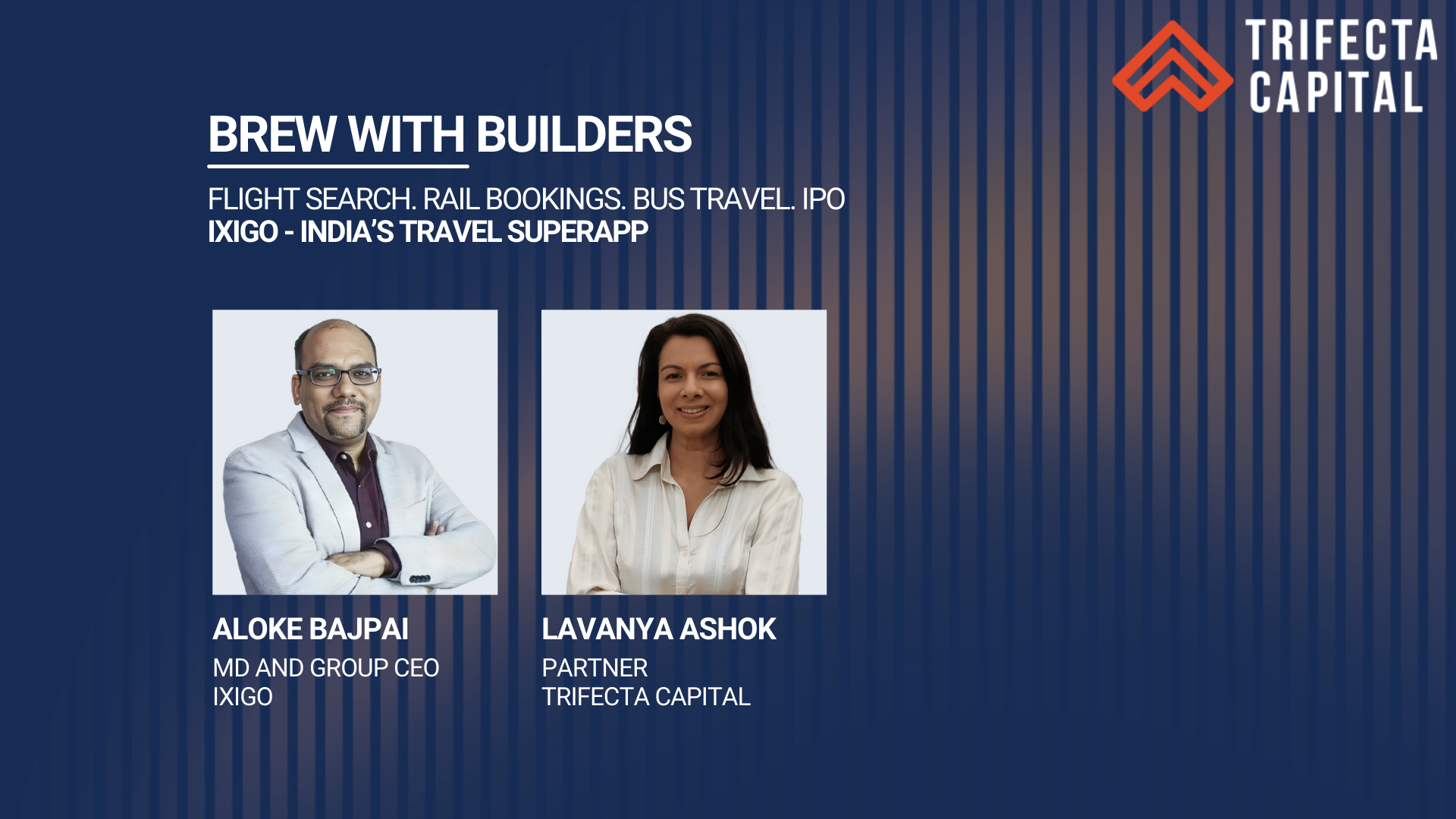


This is the full transcript of the Brew with Builders session featuring Aloke Bajpai, MD & Group CEO of ixigo, in conversation with Lavanya Ashok, Partner – Growth Equity at Trifecta Capital. The transcript has been lightly edited for readability while preserving the original discussion in its entirety. For a condensed overview of the key insights and themes covered in this session, click the Summarize AI button available on your preferred platform.
Welcome and Introduction
LAVANYA [Host]: I'm here with one of my favourite founders. I know we shouldn't have favourites, but secretly Aloke is the best of the best.
He started ixigo with his IIT batchmate, hostel mate, and then roommate, Rajnish. And as he'll correct me, ixigo is now 18 years old — a fully grown adult. In this journey, Aloke has seen many twists and turns. He's navigated near-death experiences, funding winters, the global financial crisis, and COVID — all of which, as many of you in the travel industry know, have had disproportionate ripple effects on travel. He's navigated all of that. He's now the founder of a company that's been listed for almost a year and a half, and he sits here today to share parts of this journey. Really excited for this.
Aloke, let's start with the big one — the IPO. How has life changed since going public? And when you stood at that listing ceremony, with your family, your children, your wife, your father — how did that feel? Take us to that moment.
Life After the IPO: Redemption, Responsibility, and a New Kind of Confidence
ALOKE: First of all, thank you so much for heaping so much praise on us. We've been lucky to be not just the first investment for Lavanya, but possibly also the best performing one.
Going back to the IPO day itself — I did not believe it was happening until I had actually rung the bell. One thing very unique about the ixigo journey is that we never got anything easy. This was our second attempt at an IPO. We had pulled back the first attempt in 2022 because the markets weren't friendly. For me personally, that moment after ringing the bell — standing with Rajnish and saying "finally, it has actually happened" — was deeply redemptive. It took 18 years to get there, and then another three years just to start the process and reach the other side.
How has life changed? Everybody asks me this — the very next day people were already asking. The honest answer: not much has changed in how we think about building the company or how we operate.
There are only two small things that are genuinely different. First, we were never a company built on hype or on being in the limelight. We are not used to the signal-to-noise ratio that now exists in our lives. Suddenly, everybody wants to meet you for no particular reason. Some of them are your shareholders and you can't say no. The volume of inbound has been hard to handle — and we were a company that for years went out trying to raise money and often couldn't, or raised it only when we were almost at our last penny. Being on the receiving end of this kind of attention is genuinely overwhelming for me.
Second — and this is the more meaningful change — we now have more confidence in ourselves than we ever had before. Millions of ordinary Indians are backing you. Hundreds of public market funds are backing you. It's a validation that forces you to think bigger and become bolder in how you imagine your company's future. Earlier, resource constraints were a constant — funding never came easy, we had well-funded incumbents in our space, and for a long time nobody in travel was making money. Now we can raise capital in a very short period when we need to. That feels very different.
The Prosus Investment and the AI-First Bet
LAVANYA: You've raised about ₹670 crores in primary capital life-to-date including the IPO, and now there's this almost ₹1,300 crore infusion from Prosus. Large global internet majors are saying you're a core part of their India strategy and they want to own at least 15% of your business. Talk to us about how it feels to be ready to meet this moment — and you've always been the type of founder who wants to disrupt before you get disrupted.
ALOKE: This Prosus transaction — we felt we should take some primary at this point for two big reasons.
First, the world right now is at a very unique inflection point with respect to what AI will do to it. It's very hard to imagine what companies in every vertical will look and feel like five years from now, given the capabilities that are being unleashed. But it feels very similar to when the app ecosystem arrived and nobody knew what the best app would look like — or when the internet came in and nobody really knew what you could build on it. When we were first exposed to the internet in college, it felt like a superpower: you could build anything, take it live, make money. Then the app ecosystem arrived and we were one of the first to latch on — the train utility app became the dominant app for the next billion users, though nobody could have imagined that when Android was announced.
This is that kind of moment. If we look back five years from now, we will say we were using the worst AI that ever existed. The AI we use today is the worst AI there ever will be — and yet we are amazed by its capabilities. That means it's time to double down and ask: what does the AI-first travel company of the future actually look like? Give it whatever resources it needs to come up with a version of ourselves that may disrupt our own core. We've done this before — when we were a flights meta-search, we disrupted ourselves by betting on trains as a growth vector when the app era arrived. So this is the reinvention moment, and Rajnish and the team are working day and night on what ixigo of the future will look like.
Second, we are not present in a meaningful way in hotels — despite having the largest user base in Indian travel, with around 544 million annual active users and over 80 million monthly active users. The question we want to answer is: why, despite OTAs having been around for 20 years, has less than 20% of India actually booked hotels online? On the budget segment, penetration is only 10 to 12%. The dominant channel for a budget hotel is still a walk-in because people do not trust online platforms when it comes to content, pricing, and reviews. People are getting bumped, not getting the rooms they booked. It's a massive trust issue — and a hard problem, but worth solving. The trains app took four to five years without monetisation before we said let's try to monetise. We're prepared for that kind of long-term commitment here too.
Beyond those two, we've done three acquisitions in the last four years — ConfirmTkt, AbhiBus, and more recently Zoop — all of which have played out nicely. The management teams are still with us, building with us, in an independent-ish manner. Our philosophy was: don't change anything, keep working like founders, keep treating it like your baby — but we'll throw all the resources, knowhow, and growth levers we have at you. Within that framework, we look for great founders, great teams, and frugality. We've been capital-efficient ourselves, so we have a strong bias for that. With an expanded balance sheet, we can now evaluate opportunities that would previously have been out of reach. And for the first time, we also want to invest meaningfully in brand — we've gotten here with a fraction of the brand spend of our incumbents, but that doesn't mean we shouldn't do it going forward.
The Acquisitions Playbook: ConfirmTkt, AbhiBus, and Going on Offence During COVID
LAVANYA: There have been many cases of M&A gone wrong, but across ConfirmTkt, AbhiBus, and Zoop, you've managed to integrate even during tough times. You did both ConfirmTkt and AbhiBus in quick succession in 2021 during COVID. Can you give us some insight into what it took to get those founders motivated under the same roof?
ALOKE: Both companies we'd been tracking for at least a couple of years. We knew the founders — we'd met them, had been talking to them, and had been empathising with their journey.
During COVID, when all companies were at near-zero revenue, we had one of those Zoom calls with both of these founders — just an empathy check. How are you dealing with it? How are we dealing with it? And what we realised was that the way we were all thinking about the crisis was very similar: this is temporary, we are building for the long term. Both teams were already thinking about what happens when travel reopens and how to be big at that point. As things started to open up, both companies scaled very quickly.
That improved our conviction — to the point where we wanted to acquire them even though we didn't quite have the money. We were semi-broke at the time; we had just enough capital to survive. I went to my board and said: it's the middle of COVID and I want to acquire companies — can you help me with some money? Those conversations were taking a while. I went to Rahul at Trifecta and asked if they could lend us some money to acquire ConfirmTkt. Trifecta spent a lot of time understanding the companies we wanted to acquire and moved very quickly — they came in and helped us build the conviction from a capital standpoint. Once ConfirmTkt was done, we had inbound interest because not many online travel companies were acquiring during COVID. That's when we said: let's also do AbhiBus right now, because three to four years down the line the founder might not want to sell to us anymore.
Both companies were not burning money at the time of acquisition — ConfirmTkt was already profitable six months after the lockdown, AbhiBus was breaking even. Our conviction was that as travel bounced back, both would be profitable with our ability to improve the product, scale the business, and apply our playbook.
Between February and August 2021, we made two acquisitions, raised a round, and filed for our IPO — all over Zoom. In hindsight, being bold when others were being fearful made all the difference. Most companies were laying off people and playing defence. We hired more people that year, acquired two companies, and went on offence. I think that's what separated us.
Culture as Action: What ixigo Actually Did During COVID
LAVANYA: One thing we've always been impressed by is your say-to-do ratio as a management team. You didn't fire anyone during COVID. You all took voluntary pay cuts. Some of you went without salary for an extended period. The goal was: refund customers, keep your commitments, keep the team. That's not an easy culture to build in a travel company during COVID, when there was no visibility on when lockdowns would end. How do you keep that culture intact now that you're a large, listed company with new people coming in?
ALOKE: Culture is not posters on the wall or ten commandments. It's what you actually do. What you do is who you are. The actions of the founding team and leadership during a crisis — and equally during very good times — create culture. Being disciplined in good times and transparent in bad times is what it's all about.
The mistake we tend to make is to pretend everything is fine when things are going wrong, and to go overboard when there's abundance. Both are the wrong state of mind. Being unaffected by external circumstances is easier said than done, but if you can maintain that as a founder, you focus on what truly matters.
When we have been in crisis, we've gone to the whiteboard, drawn out our P&L, and told the team exactly what we're spending on and why, and how much we make. The solution often comes from them. This is what we did during the 2008 global financial crisis. We were in the middle of a Series A fundraise when Lehman collapsed. We had about three to four months of runway and a team of 25. We got into a room and I said: we need a solution, otherwise we'll have to let people go, and that solution better come from all of us. We drew our P&L on the whiteboard. A young engineer stood up and said: if we all go without salary for 12 months, won't the company be saved? Not entirely practical, but it started the conversation. Eventually we worked out a structure: founders to zero, leadership to 70% pay cuts, the next level to 50%. We checked the numbers — it worked. We went to the landlord, who agreed to half rent. The team did not leave us for the next five years, and we gave ESOPs to everyone who made that sacrifice.
That gave us a template. When COVID arrived, we already knew what to do. We had a nightmare scenario: what if 12 months go by with no travel recovery? I told the team — in 12 months, if nothing comes back, all travel companies are dead anyway. So we might as well die fighting. But does that mean we hold back customer refunds to survive ourselves? That's unethical. Does that mean we hold back salaries of people struggling at home? Only to the minimum extent needed to survive. Within six months of things opening up, we brought everyone back to full salary and gave appraisals.
The karma we earned from customers during that time — refunding money faster than anyone else — paid back very quickly. People trusted us. Word of mouth was very strong. We were the only OTA, possibly in the world, that had more revenue in a COVID year than in the pre-COVID year. The six months that came back came back with a vengeance.
Choosing the Right Investors: Conviction Over Valuation
LAVANYA: Fundraising has always been hard for you — except perhaps now. You've had Elevation, PeakXV, and now Prosus. How did those relationships shape this journey?
ALOKE: We've had perhaps the best partners we could have found in this ecosystem, and we've been very lucky — including Trifecta. Elevation has been on our cap table for about 14 years, PeakXV for almost eight.
In both those fundraises, the interesting thing is that these were not the funds offering the highest valuation. And this happens in every fundraise — you have a lead investor who does all the work, who will give you a price. Then other investors come in saying they can give you a better price without having done any of the work. Remember: that person is coming in with half the conviction of the person who did the work. Look at the quality of an investor through the lens of how they actually operated in companies they got into. How long-term are they? How did they behave in a crisis?
In our case, both Ravi Adusumalli from Elevation and Shalesh Lakhani from PeakXV were extremely supportive of letting the founders operate the way we believed the company should be run. In every decision we made during a crisis, we got support. And we were transparent with them — if we were in trouble, we would go to them quickly and tell them exactly what had gone wrong.
We were not always good at delivering what we said we would, to be honest — especially in the early years, we would miss our budgets. But adversity teaches you the most. In 2019, after a fundraise that didn't materialise despite several conversations, we told ourselves: we need to get out of this fundraising rut. Everybody wanted to be a unicorn and keep raising rounds till you got there. We didn't want that. We wanted to build something sustainable. In February-March 2019, we created a plan to chase profitability. We started tracking daily P&L and cash flow — because if you only look at it at month-end for your investor report, it's too late to course correct. The only real mantra is to improve yourself 1% every day, but you'll only do that if you're looking at your numbers every day.
By January 2020, we had our first profitable month. One quarter before COVID, we had our first profitable quarter. Of course, COVID then arrived and ruined those plans before we could tell anyone. But that one year of discipline remains with us to this day — we now look at these things by the hour, not just by the day.
The other fundraising mantra: raise money when people chase you, not when you chase them. Do something so valuable that they start coming to you. The risk of being on the other side — raising too much capital at too high a price — is that it ends up killing companies. We were on the opposite extreme, having raised less than we needed, and it created the right DNA. I wish that kind of pain and adversity on all of you — that's what creates culture and builds companies.
Navigating Public Markets: Long-Term Investors, Communication, and Not Watching the Ticker
LAVANYA: Now that large institutions and retail investors own you and can buy and sell your stock at will — how has the founder-investor relationship evolved?
ALOKE: When you're private, you have a handful of investors on your cap table. If you miss your budget by a bit or exceed it, most of them don't care in the short term — they're there for the long term and want to see the company compound over five or ten years.
In public markets, sentiment can sometimes override fundamentals. But the best, longest-term investors behave very similarly to good private equity or venture funds. Their diligence process is similar. Their view on the long term is similar. They don't care too much about one or two quarters as long as you're directionally pursuing the story you told them when they came in.
This is why quality matters over quantity even in your public cap table. If you have the right quality of investors post-listing, you'll have less volatility and you'll feel freer to invest in things that make long-term sense even if they have short-term costs.
A lot of the sentiment around public companies is about how you communicate. We've tried to overcommunicate rather than undercommunicate, because undercommunicating leaves room for interpretation. We write long, detailed FAQs in our earnings releases — if five investors asked us the same questions when we met them, we'd put those questions and our full answers in public because that's the honest way to operate. As long as your narrative is supported by your execution, people will like what you're doing. When they diverge — that's when problems start.
We had one quarter where we grew 70%-plus. The previous quarter we had already flagged that such growth was an exceptional period. We then grew 37% and there was some market reaction. But if you're building for the long term, you should not be moved too much by the reaction on either side — whether things go up too much or down too much. As long as the long-term story holds water, that's what matters.
The Origin Story: Two IIT Boys, France, and a Swades Moment
LAVANYA: I've saved the origin story for now that we have a full house. You come from a modest background — neither you nor Rajnish came from wealth. Rajnish actually had personal debt when he made the entrepreneurial leap. You both had great jobs at Amadeus in France. You were living in Côte d'Azur — where people go for vacation. Yet you wanted to work more hours than the country's rules permitted and decided you needed more excitement. Tell us about how ixigo began.
ALOKE: We are both Tier 2 city boys, and yes, we were living in Côte d'Azur in France for about four years before we chose to leave and come back to India.
There were three things driving that decision. First — if you ever work for a large European conglomerate, especially in France, you quickly realise they don't want you to work more than 35 hours a week. If you do, you'll get a call Monday morning asking why you came in on a Saturday. So the first trigger was: did we go to IIT for this?
Second, it was 2006 and China and India were dominating every newspaper headline. We were saying: what are we doing outside India? We should be back home building something.
Third was Steve Jobs' 2005 Stanford commencement speech about connecting the dots. We connected ours: travel, tech, India, bored, move back, build something. And then Swades happened — that scene in the train, the one rupee, the feeling of what are we doing for our own people back home. All three triggers came one after the other.
It was an emotional decision. Most founding decisions are emotional — if we ran spreadsheets, we wouldn't start companies, because they'd show us we'll be broke very quickly. And we were semi-broke at the time. I still had my business school loan to pay off. Rajnish had personal liabilities. But we started anyway.
The key to surviving and thriving over 18 years is to never assume your current state is the steady state. Everything changes. AI is going to change everything again. So you have to continuously take bets on new things that may end up defining you. Those bets will often be counterintuitive — people will say your core business will suffer. But your core business is going to change anyway. You have to take those bold decisions. The time span for these S-curves used to be 10 years, then it shrunk to five. I think now it'll be even shorter. You have to be more agile, less wedded to your current existence, and continuously evolving toward where you believe the future will be.
The Personal Cost: Family, Spirituality, and Staying Sane
LAVANYA: A lot is talked about the success founders have once they make it, but there's also a very real personal cost to chasing these dreams. Parents, spouse, children — your son just celebrated his birthday. Can you talk about what this journey has meant for your family and how they've supported you?
ALOKE: It's been a journey with a lot to learn, and you learn the most from failure. I've failed many times over, and that's how I've gotten here. The costs have been many — including my hair.
Running a company is a great sacrifice. If you're a passionate founder, there is genuinely no time off. Even on a Sunday watching a show, at the back of your mind you're thinking about something. That's practically what it is. There's no time off unless you switch off your phone entirely and your wife says "hey, focus."
What I've found helpful over time is reconnecting to my spiritual roots. Adversity takes you there sooner than anything else. When our first IPO attempt had to be pulled back, I went on a 10-day Vipassana course — no phone, no communication, meditating all day. It was deeply humbling and helped me stay sane.
My family has been a huge support. That hour I get to spend with my kids in the evening, or the Sunday with the family — I look forward to it every day. Before I got married in 2009, it was mostly my parents who supported me. My father is still my spiritual anchor — the person I go to when the going gets really tough. And the other thing I've found genuinely useful is music. When you have nothing, you have music to soothe you. Listening to an uplifting song in the worst of times will always bring you back.
Rapid Fire
LAVANYA: Before I let the audience in — a quick rapid fire.
LAVANYA: One word that best describes your 18-year journey with ixigo.
ALOKE: Resilience.
LAVANYA: A book, podcast, or person that's influenced your leadership the most.
ALOKE: Steve Jobs was definitely someone I followed a lot in my early years. He inspired many of the ways we thought about building new things. So — stay hungry, stay foolish.
LAVANYA: When are you at your happiest best?
ALOKE: This might sound counterintuitive, but I'm more comfortable during adversity than during good times. Hype cycles give me a little bit of stress — because then you know something is coming.
LAVANYA: Any hacks for creativity and productivity?
ALOKE: Delegation — though it goes against the founder instinct to control everything. We've tried to build a next layer of leaders running our lines of business. We have a philosophy of trust but verify: everything gets published on Slack and you can check in, but about 90% of the time we don't interfere with what those leaders are doing. That's helped enormously.
LAVANYA: What's the hardest decision you've made as a founder?
ALOKE: The hardest recurring decision is always when you have to let someone go because they're not a great cultural fit. We hate letting people go — but a poor cultural fit is the only truly valid reason to do so.
At the company level, the hardest decisions have always been about what to do with limited resources during adversity. What I've found is that if you're doing the right thing for the customer, you can never go wrong — at least in B2C. Put yourself in the customer's shoes. How would you expect to be treated? That template always works.
We don't have scripts for our customer support team. We've taught them to deal with things like a human — listen, resolve, use natural language like you would in a real conversation. The reason a human is there on the other end is to treat the other person like a human.
LAVANYA: Last question from me — if you weren't running ixigo, what would you be doing?
ALOKE: I had a childhood dream of being an archaeologist, and I still read a lot of history content and podcasts. I might go back to something related to that.
Audience Q&A
On Staying the Course When Competitors Raise Big and Make Noise
AUDIENCE MEMBER: You spoke about long-term strategy and being true to your story. But when competitors like OYO come in and raise huge amounts, how did you think about it? Did you ever feel the need to pivot or reconsider?
ALOKE: The single biggest mistake you can make as a founder is to do something because someone else did something — because they raised money, or because they're getting more attention. Be honest with yourself: none of that matters. The only thing that matters is whether your customers are happy with what you provide. If yes, that cohort will keep growing. If no, it'll keep declining. That's the only truth in B2C. Constantly improve until you are good enough.
Another company in your space has a different customer base, a different context, a different DNA — it's apples and oranges. The moment you stop caring what your peers or competition are doing, that's the only zone worth operating in. Your blood pressure will thank you, because you can't control what the other person does. They go and raise a billion dollars — you can't control that. If your product is loved, people will keep coming to you regardless of the noise. Discounts will attract discount-seekers, not loyal customers. Don't let your team get obsessed with the noise either. If you consistently deliver the best customer experience, you will keep winning. That's it. Nothing else matters.
On Viral Marketing Without a Big Budget: The Ashish Chopra Story
LAVANYA: Since we started the firm, we've been big fans of Ashish Chopra, your team's social and viral marketing lead. He was with you for almost a decade. Can you share a bit about how you found him and how that culture of creative, low-budget marketing was built?
ALOKE: We didn't have money to spend on Bollywood celebrities or TV. So around 2014-15, we said marketing and social are going to be our play.
Ashish had made a video about paying it forward at the Delhi-Gurgaon toll. He was paying the toll for the car behind him and asking them to pay for the next. The video went viral. He had applied to us about a month earlier and I hadn't called him. I saw that video, called him the next day, and said I want to meet you. Because what he was doing — he did it purely out of love for the craft. That's how we found Ashish.
Part of what made that culture work is that we were never trying to make ads. We were just having fun. We launch an April Fool's video every year — it's just the team and me messing around. We don't expect it to go viral. We have no expectations from it. We just want to have fun. Some things you do for the pure love of doing them, and those are often the ones that resonate.
On Starting ixigo and What Aloke Would Build from Scratch Today
AUDIENCE MEMBER: How did you come up with the idea for ixigo? And if you had to start something today from zero, what problem would you want to solve?
ALOKE: ixigo launched in 2007 as a meta-search and comparison engine during the desktop era — there were only 15 to 20 million internet users in India, all on broadband, opening multiple tabs to compare prices. That was the original idea.
The train app came from a very simple observation. Whenever we travelled by train, every few minutes someone would ask about PNR status. People were checking their waitlist position every 15 minutes — 100, 80, 60. In 2013, we noticed these were the most liquid use cases in India. Almost everybody had this problem. Nobody was solving it. We built the app purely out of passion, with zero expectation of monetisation. A million downloads in the first year, and it kept compounding year on year. By year four or five we were doing more downloads every day than every other OTA combined — but we weren't monetising anything. That's when we went to IRCTC and asked if we could please sell tickets. We got the partnership in place in 2017.
In hindsight, it's the classic internet playbook: solve a real problem you're passionate about, with zero expectations of returns, and if it's genuinely valuable, the scale will come. If you have scale, you'll figure out how to monetise. There are very few examples of this in India, but it works. Solve real problems, get scale, then figure out the money.
On Competing Against Deep-Pocketed Players Without Matching Their Discounts
AUDIENCE MEMBER: You talked about cash backs and discounts as a reality. How do you balance that against profitability when a well-funded competitor is trying to outspend you?
ALOKE: In most of the verticals we operate in, we're competing on product and customer experience, not discounts. Trains is the best example — we charge a service fee. We give zero discounts. But people willingly pay because they see value in what we provide.
Getting a product or customer experience to the point where that becomes the singular reason people come to you is very hard. But that's where we spend 80% of our time and energy, because it's the part that's defensible. Sales and discounts are part of the game and you have to play them to a degree, but they should never be your singular growth lever. Companies that get over-obsessed with discounts create the wrong culture — for their marketing teams and for the organisation overall. It's easy to throw money and get growth. But money is not cheap, and at some point you run out of it. We've seen this playbook multiple times in travel.
I've never had the deepest pockets in this space. Even today, there are players with more capital than us, and we are growing faster than them. Building a superior product experience takes far more effort than throwing discounts — but it's much more defensible. The other template is known to everyone; this one you have to discover for yourself. It's harder. But it's worth the effort.
On Profitable Cores, Investing in Growth, and Public Market Valuations
AUDIENCE MEMBER: As a startup founder, any surplus you generate can be reinvested to grow faster. But public markets look at profitability as a valuation marker. How do you balance that tension?
ALOKE: It's a great question, and I'll be honest — the market is more qualified than me to answer it. But here's my philosophy.
At a certain scale and maturity, every company has to make money. The only truly intrinsic valuation is a DCF — discounted cash flow. Price-to-earnings and price-to-revenue multiples are derived multiples. Don't get swayed by what you see on social media. If you really want to understand any company's valuation, build a DCF and figure out what cash flows they'll generate over five to ten years.
If you have a core engine that can stand on its own feet, people are willing to let you invest in adjacent areas for a few years. Every large company does this — Apple, Google, Nvidia. In India you have listed examples of this too, and the market understands it. Zomato is a good example — they're saying we want to build something game-changing in a new vertical, it requires investment, and as long as that's communicated clearly, investors appreciate it.
My advice: don't list if you cannot have a profitable core either before listing or very shortly after. But investing in new areas where the TAM is large and the customer problem is deep — investors who understand long-term value will back that. There will be naysayers; there always are. But you just need believers. And your conviction should come from one question: is this the right thing for the customer? If yes, commit to it.
On Building Teams Across Stages: Zero to One, One to Ten, Ten to One Hundred
AUDIENCE MEMBER: There's a notion that the talent required to build from 0 to 1 is different from 1 to 10, and then 10 to 100. How have you managed those transitions?
ALOKE: It's definitely different. In the early stage, you need people where the quotient of passion, commitment, and risk appetite is way higher. Over time, you need domain expertise and people who have seen hyper-scaling, because that takes a very different temperament.
Some people will adapt through all these stages and remain relevant. Some are genuinely suited to zero-to-one and should be put on discovering new things within your ecosystem. Horses for courses.
The best mental model I've found: inside your company, some parts will always be at seed stage, some at growth stage, and some more mature. You need the right kind of team for each of those parts — staffed the way a startup would be in its early days, or the way a scaled business should be. Think of it less as company stages and more as different modes that coexist at the same time.
End of session